Showing posts with label Book Reviews. Show all posts

Wednesday, September 22, 2010

Book Review: Checklist Manifesto by Atul Gawande

I really enjoyed The Checklist Manifesto: How to Get Things Right.  It wasn't really what I was expecting, but it was extremely interesting and I liked it a lot.

I started this book thinking it was a self-help(ish) book about how people could use checklists in their every day lives to keep themselves organized.  Heh.  This is something I always tell myself to do more. 

But Gawande focused his attentions on the use of checklists in three major fields: airplane pilots, medical facilities (mostly surgery) and building construction.  Each industry used checklists to help navigate every complex procedures and to make sure everyone was on the same page.

By going through a checklist before surgery (or flights), it helped make sure that those small, but critical, steps aren't missed and that everyone was prepared if things did in fact take a turn for the worse.

Gawande also discusses how people don't want to use checklists even though they're really freaking effective. We love the idea of the maverick doctor or pilot (don't tell me what to do!) and the idea of making every follow these checklists seems weird.  We don't want these professionals to lose their autonomy.

But people make mistakes. Even the best of us. And going through a checklist can help prevent... well... these preventable mistakes (stuff like wrong dosages or procedures).  Using a simple checklist drastically cut down on many routine errors and saved lives (Gawande helped devise the checklist in this link).  It really is amazing how well they worked. It's practically a miracle drug.

And while Gawande never brings up using a checklist in your every day life, it isn't too hard to reach that conclusion on your own. If these simple checklists can help surgeons and airline pilots, I'm pretty sure they can help Ben Cox.

The book itself is fairly short, clocking in at 224 pages and Gawande is a good writer.  I wouldn't say the book flew by but it wasn't a long tedious slog to finish either. Anyway, I recommend it. It's definitely interesting and possibly even useful.

Saturday, August 21, 2010

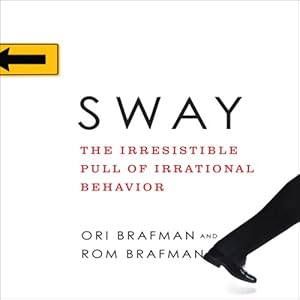
Book Review: Sway by Ori and Rom Brafman

Sway: The Irresistible Pull of Irrational Behavior is a very interesting book. Basically, the book is about why we do certain (re: dumb) things.  Brafman brings up a lot of interesting studies (including a few sports examples, which I'll get to in a bit) and he talks about how we categorize things and people and how we're biased to our initial diagnosis, even in the face of evidence.

The Brafman's writing is approachable (nothing too jargony) and the book is a fairly quick read (it clocks in at just under 200 pages).  In fact, I wish Sway was a little longer and more fleshed out.  Brafman tends to jump around ("to better understand problem X, we must first learn about some seemingly unrelated study") and I could've gone for some more info.

Brafman discusses a study which found that NBA's players playing time depends on his draft status (don't tell Adam Morrison):
Staw and Hoang found that the variable most responsible for an NBA player's time on the court - "above and beyond any effects of a player's performance , injury, or trade status" - was his draft selection. Even after controlling for all other factors, in a given season "every increment in the draft number [e.g., getting drafted ninth instead of eighth] decreased playing time by as much as 23 minutes."  Incredibly, draft order continued to perdict playing time all the way through a player's fifth yaer in the NBA, the final year measured in the study.

But draft order had even deeper inplications.  Being picked late in the draft increased a player's likelihood of getting traded to another team and ultimately affected the longevity of his career.  "A first-round draft pick," found Staw and Hoang, "stayed in teh league approximately 3.3 years logner than a p layer drafted in the second round."

Now remember, Staw and Hoang had isolated draft order from all the other variables. That means that if you have two players with the exact same toughness, scoring and quickness record, the one in picked earlier in the draft would get more playing time, be much less likely to be traded, and have a longer career than his counterpart, who-although he turned out to be just as good-had the misfortune of being picked later in the draft.

Let's pause here.  Are Staw and Hoang saying what we think they're saying? If we think aobut this rationally, once a player is picked, his draft order shouldn't matter. After all, coaches and mangers should only be interested in a player's level of productivity on the court and his overall fit within the team.  Once the draft is over, the draft number becomes an arbitrary statistic that gives no indication of how he'll actually perform on his new team.

But here's where value attribution meets up with a sway called diagnosis bias-our propensity to label people, ideas, or things based on our intial opinions of them-and our inability to reconsider those judgments once we've made them.  In other words, once a player is tagged as a "low pick," most coaches let that diagnosis cloud their entire perception of him.  It's as if each athlete wears a permanent price tag on his jersey.  [Pages 69-70 in the hardcover]

This seems crazy but it kinda makes sense.  I'd imagine that a player drafted in the first round is going to get more chances to prove himself or figure it out because he's been deemed to have "first round talent" (and who knows, maybe he can get even better!).  I wonder if draft status affects NFL players in the same way (I imagine it does, but not quite to the same degree).

The book is filled with a whole bunch of examples like this.  Another interesting idea is that we have the tendency to follow the group, even if we think/know the group is wrong unless someone else speaks up.  The thing is, the someone else speaking up doesn't even have to be right themselves, they just have to speak out against the group (basically make it OK to contradict the masses) and then we feel comfortable doing the same.

Anyways, Sway was a fun, quick, read and I highly recommend it.  The examples were quite interesting and it really makes you think.

Friday, May 15, 2009

Book Review: Prelude to a Super Airplane

So I did my book preview of Brian Spaeth's Prelude to a Super Airplane on February 4th. Today is May 15th. I am awesome.

Did it really take me that long to read this book? Hell no. But it may have taken me a month or so to actually get into it.

I'll be honest, I'm always wary when friends ask me to give opinions on their work. Why? Well, I'm opinionated and I don't like bullshitting. So if I don't like it... I'll tell ya (which I guess is good, but can be uncomfortable). And at first, I didn't care for the book and I put it off.

It was stupid, pretentious, riddled with spelling errors (though purposely) and had a cast of characters I couldn't follow at all (nor cared about). Like I said, it took me awhile to get into it. But eventually, something clicked and I just 'got it' and from there on, it was really fun.

There is a certain charm to the book. Spaeth parodies Hollywood films and archetypes very well (similar to South Park, if that comparison makes any sense). Sure, he makes himself the main character, uses (what I assume are real) Facebook chats for entire chapters, he breaks the fourth wall repeatedly, he's included inane quizzes and the book is filled with inside jokes and bizarre references (Calvin Stadiums!). Somehow it all works and I was actually pretty bummed out when it ended (to the point where I'm actually intrigued by this Brad Radby book).

The book probably isn't for everybody- however, the chapters are short (Da Vinci Code style) and each one features a chapter number so large that you don't need a bookmark (so it's got that going for it). However, to say you have to suspend disbelief is an understatement. Though despite my early apprehension, I'm really glad I finished it (kinda like how I was with Jonathon Strange & Mr. Norrell- though these books couldn't be more dissimilar). Was my first impression (this is really dumb) off the mark? Probably not. But Prelude to a Super Airplane is deceptively clever and well worth the minimal effort that I put in.

(and speaking of minimal effort, it only took me 10 days since I told Brian I'd have a review posted! huzzah!)

Wednesday, February 04, 2009

Pre-review of "Prelude to a Super Airplane"

The following is a review for Brian Spaeth's book Prelude to a Super Airplane, which I have not read. The idea is that I'll review the book before I read it, proceed to read said book and then post a review afterwords, seeing how close I get. I've done my best to stay away from any and all spoilers, plot twists, plot and characters.

(Full disclosure: I'm friends with the author. I helped destroy his old blog in great blog suicide of 2007. I was also an extra in the long rumored Who Shot Mamba? movie and I was recently interviewed on Brian's new blog. Also, we both went to Hudson High School).

Like many of you, I started reading Brian's work over at his blog YaySports because of his ridiculous NBA photoshops and unique(ly hilarious) writing style. Thankfully, Brian didn't try to do any "branching out" and Prelude to a Super Airplane is filled with that same witty writing, awesome NBA photoshops (Ron Artest fighting an airplane? Totally awesome!), the talking snake Mamba and of course, the Orange Roundie.

The best part of the book (by far) was Spaeth's highly original use of airplanes. The title is both dead on and a bit of a misnomer, as the airplane is ridiculously super but the word prelude is simply tacked on for show.

And that airplane is awesome. I don't want spoil anything, but this thing is 47 stories tall and kicks total ass (again, it fights Ron Artest in a hilarious photoshop montage). The characters are all fully developed and the story is gutwrenchingly true to life.

Unfortunately, Brian falls victim to many of the short falls of most blogging authors. I assumed Brian was joking when he said he wrote the book in just seven days, but now I'm not so sure. The book is riddled with spelling errors and is filled with words that I'm pretty sure he made up himself (and not in a good way, like in fantasy books).

If I have one complaint with Prelude to a Super Airplane, it's that it's too long. With the elaborate plot, large cast of characters and long, drawn out explanations on how a 47 story airplane actually works, you can easily find yourself confused. I recommend keeping a pad and paper next to your beside while you read, to jot down notes so you can keep up.

All in all, I highly recommend Prelude to a Super Airplane. It's funny, it's intelligent and the characters are really easy to relate to. You can purchase copies of Prelude to a Super Airplane here and other places (I assume).